Parambil Launches Vault: A Major Infrastructure Investment to Make Complex Medical Litigation Faster from the First Upload
%20(2).png)
NEW YORK — Parambil, the AI-powered litigation platform purpose-built for complex medical cases, today announced the launch of Vault, a significant investment in its core case architecture. Parambil was built from the start around handling the most complex and document-intensive cases in plaintiff litigation. Vault is a continuation of that focus.
As the platform has expanded beyond medical records to support billing data, deposition transcripts, and legal documents, firms are increasingly using Parambil as a case management platform and intelligence layer across the full case life cycle. File counts on recent cases have grown into the thousands. Vault replaces the prior case format with a file-level architecture designed to handle that volume and variety reliably.
The result: most customers will be able to start querying and working within the platform within minutes of uploading their first document.
What Vault Delivers
The files law firms work with vary widely in format, quality, and structure. Vault was built to handle that reality more robustly. The new architecture processes each file independently with OCR and structured context, so the platform can work through even the most challenging documents without requiring manual intervention.
For attorneys and paralegals, the practical impact is immediate. A case becomes chat-ready as soon as a single file finishes processing. Notes and Ask AI are available right away, regardless of how many files are still in the queue. Users see clear status indicators distinguishing uploaded files from indexed files, with processing time estimates based on page count. Files and Ask AI are typically ready in approximately 10 minutes per 1,000 pages, with full feature processing completing in roughly 30 minutes per 1,000 pages.
“The next generation of legal AI has to earn attorney trust, and that doesn’t happen by being impressive in a demo,” said Liam Gordon, CTO and co-founder of Parambil. “It happens by being fast enough to matter on a real caseload and accurate enough that an attorney would stake their reputation on it. With Vault, we rebuilt the data infrastructure from scratch: splitting PDFs, OCR’ing page by page, indexing for real-time retrieval, and linking every output back to a specific file and page number. That last part matters more than people realize.”
Automatic File Tagging and Organization
When firms upload hundreds or even thousands of files to a case, Vault’s file agent automatically tags and organizes them. Medical records, billing files, depositions, expert reports, pleadings — files are sorted into the right categories without anyone having to do it manually. For firms that have historically spent significant time just getting their documents into order before they can start working a case, this removes an entire step.
Smarter Agent Access and Search
Vault also improves how Parambil’s AI agents access and search case data. Billing OCR files are now included in the agent context. File names are indexed for more precise retrieval. And users can scope which files an agent searches, giving teams tighter control when working targeted questions across large record sets.
Removing Friction Across the Firm
A major theme behind Vault and Parambil’s broader product direction is making the platform turnkey and easy to use across entire law firms. Features like automatic file tagging, faster case readiness, and scoped agent search are all designed to eliminate the small points of friction that build up over a work week or a work year. The goal is to use AI to reduce the death by a thousand paper cuts that makes work frustrating, so lawyers can focus on what they do best: legal work and legal strategy.
Foundation for What’s Next
Beyond the immediate gains, Vault serves as the foundation for a series of file management and case organization features arriving in Q2. Among them is the Record Organizer, which uses Vault’s tagging and structured metadata to help firms slice records by type, organize chronologies, and prepare materials for the specific demands of their case.
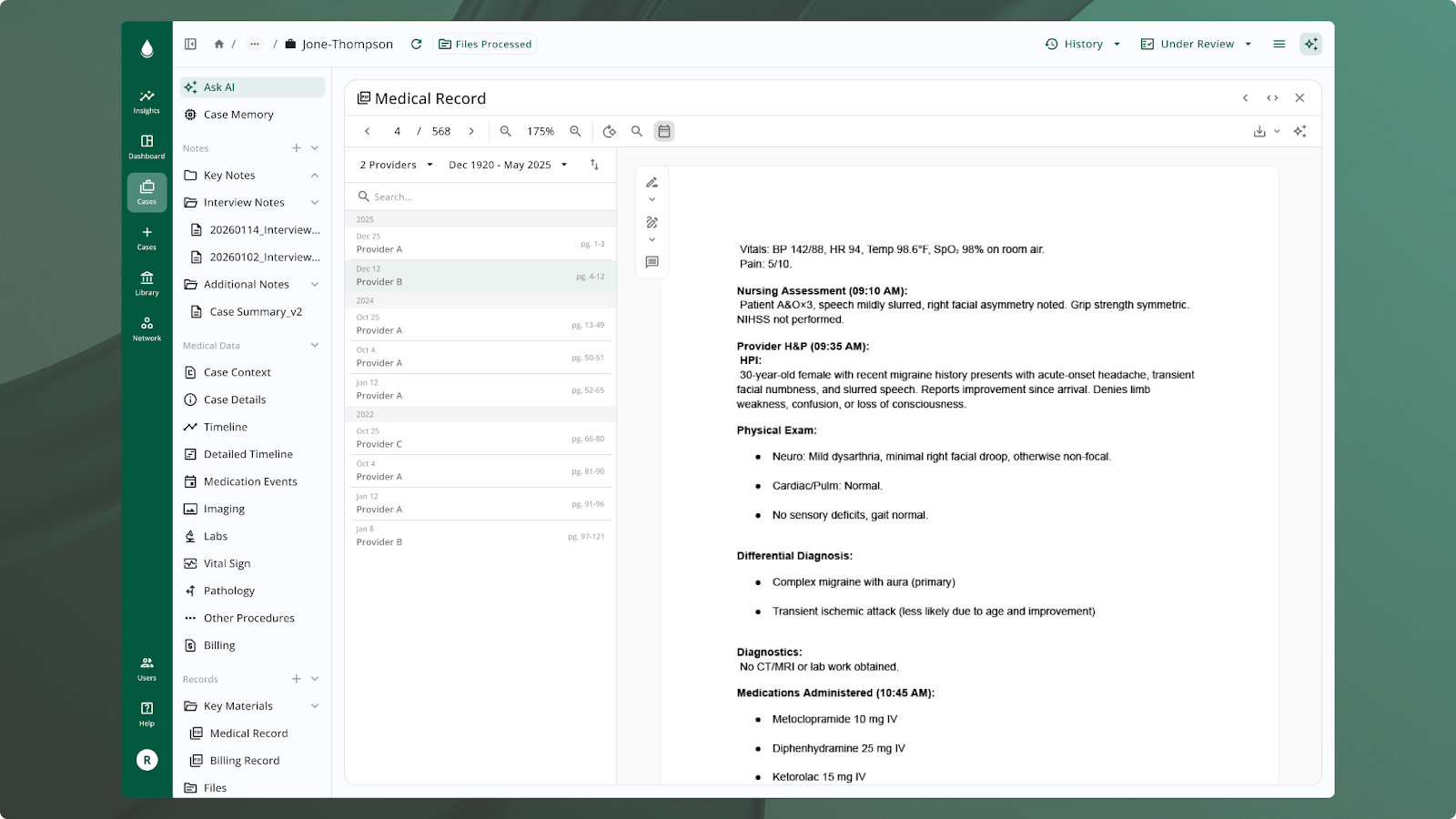
“With complex medical cases, you’re often dealing with what feels like a shuffled deck of cards,” said Paul Slager, partner at Slager Madry LLC, a leading medical malpractice firm in Connecticut. “Parambil turns that into something organized, easy to understand, and easy to share with experts and other key people on the case.”
“As much as AI is really helpful to organize information, get to insights faster, and be that second eye, great attorneys are still spending time within the medical record,” said Sara Parambil, CEO and co-founder of Parambil. “We want to be attentive to that, and we want to make sure that even their medical record viewing experience is improving with technology.”
Additional features building on the Vault architecture include hyperlinked exports, an exhibit agent, and an intake module.
Availability
Vault is live for all new cases as of April 7, 2026, following a phased rollout with an initial group of firms. Existing cases remain in the prior format, with migration available on request.